Same question,
different answers.
Can language models read between the lines?
“Have you done your homework?”

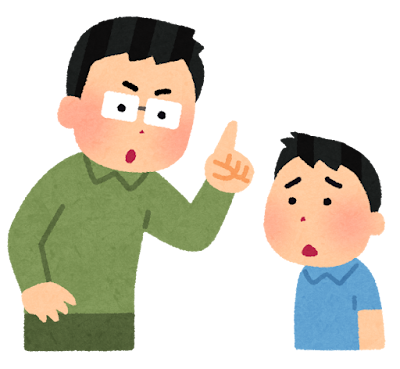
Same words, different meaning. People resolve this instantly from who is speaking, how, and why. A model that only sees the sentence reads a yes/no question, which in both cases is the one thing it isn't.

 DRInQ holds the question fixed and varies only the context, so getting an item right requires pragmatic inference, not pattern-matching. Try it:
DemoTry it: read between the lines
Which comment is the speaker most likely implying?
MethodHow DRInQ works
A base query (“Don't you feel cold?”) is paired with a latent speaker intent (scold, request, offer…). Each intent yields a context in which the same words carry a different implied comment; annotators validate that it really does.


“Don't you feel cold?”
Finding 1Humans write familiar situations; LLMs generate peculiar ones
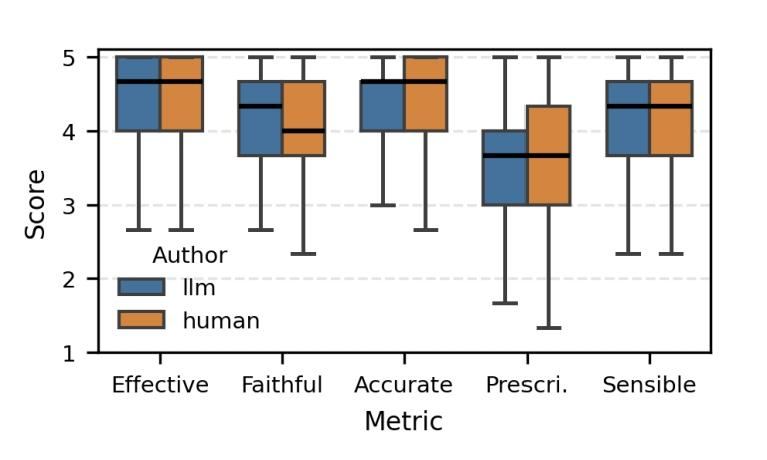
Humans and LLMs wrote contexts for the same question and intent; annotators rated both. Humans reached for safe, recognizable scenes; models wrote more varied ones that sometimes outran what the context supported.
“Are we having dinner at home tonight?” (intent: to insult)
 Human-written contextHusband asks wife after the previous night's failed cooking attempt. → Your cooking sucks.
 LLM-written contextAn adult child mocks their parent, eyeing the messy dining area. → You can't manage the house.
Finding 2LLMs can write situations they struggle to interpret
The central result. Models that write plausible pragmatic scenarios when guided often fail to recover the implication when asked to interpret one: a generation–inference asymmetry. Eleven current models land between 45% and 70%; humans average 88%.
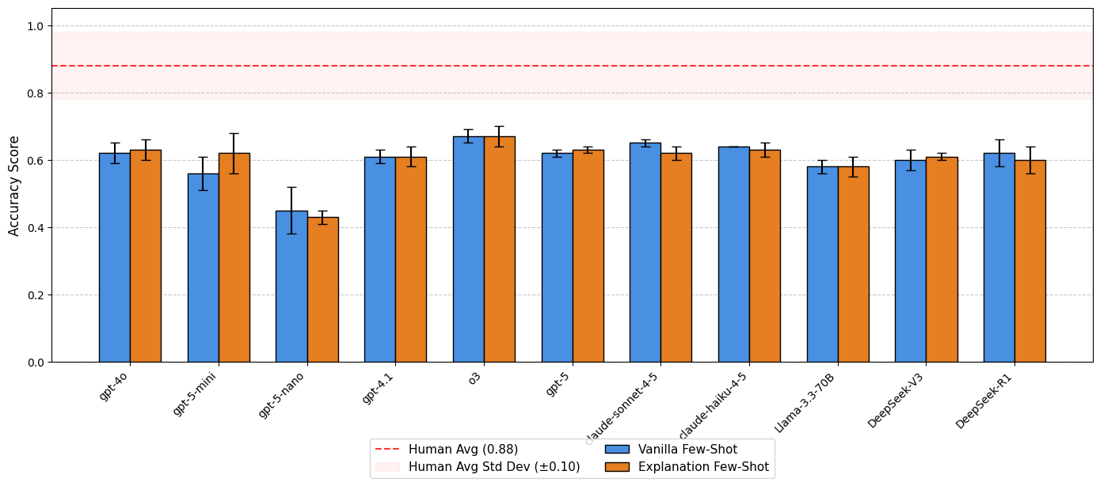
Scaffolded prompts (rule out non-specific or malicious readings; reason explicitly about pragmatics) lift small models substantially. Large models plateau near 80%.
Finding 3LLMs magnify negative details and miscalibrate inference strength
Two recurring error patterns: any negative detail in the context pulls the model toward a critical reading, even when the speaker is being kind; and models over- or under-shoot how strong an inference the context licenses.
“Want me to carry your bags?”
An older brother confidently asks his sister, who struggles with a heavy load of groceries.
Humans readI'll help!Model readsYou're clearly too weak.

“Could you please be quiet?”
A younger sibling apologetically repeats to his teenage brother, who practices passionately in a band.
Humans readPlease lower the volume.Model readsSorry for not considering your love of music.